

In his latest address to Prosperity regime officials—televised to the Ethiopian public on October 28, 2024—Abiy Ahmed emphatically claimed that his goal is not to ensure that Ethiopians have “3 meals a day”, or attain food security, but rather his “baseline goal is to achieve the 3 Hs — happiness, harmony, and human excellence.”
This comes on the heels of his past statement, on October 2, 2023, regarding his strategy for poverty reduction, he stated: “our belief is that we must see prosperity instead of poverty, happiness instead of problems, and peace instead of conflict. This requires a change in perspective and the power of our imagination.” In other words, poverty is a state-of-mind and something that can be overcome with a simple change in perspective both at the individual and country level.
Of course, economic policy, poverty alleviation, and food security are not the lackadaisical and haphazard processes that Abiy suggests. Rather, effective policymaking rests on a strategic and evidence-based approach to policy formulation, implementation, and evaluation. To suggest otherwise, and engage in deceptive political rhetoric and wishful thinking—in a country where poverty and food insecurity are persistent and endemic—is not only deeply problematic, but it is a dereliction of duty.
Unfortunately, such statements have become emblematic of Abiy and his Prosperity regime. A beleaguered regime lacking capacity to deliver socioeconomic growth and development. In 6 years, the regime has proved to be completely out of touch, non-credible, corrupt, unaccountable, deceitful, and without a modicum of regard for citizens and the public good.
Lack of a Sound Economic Strategy
Perhaps most significantly, his latest statement is further confirmation that Abiy does not have a sound economic strategy. On the one hand, Abiy falsely claims to have delivered “prosperity” and “food security”; while on the other hand, he mocks citizens’ need for adequate food and nutrition amid increasing levels of conflict, poverty, and inequality.
Unfortunately, as a consequence of Abiy’s poor governance, Ethiopia is mired in conflict, poverty, and remains food insecure. In this regard, 1) 72% of the population is in abject poverty with an additional 18% on the cusp of poverty; 2) poverty is rapidly rising in every region of the country; 3) more than 20 million citizens need emergency food aid; 4) 5.4 of 6 million citizens in Tigray need food aid; 5) more than 5,500 schools have closed due to conflict and instability, of which 4,178 are in Amhara; and 6) 5.1 million Internally Displaced Persons need humanitarian assistance, including food, shelter, and hygienic services. These challenges are in addition to the ongoing war on Amhara, where Abiy is orchestrating a senseless and brutal war.
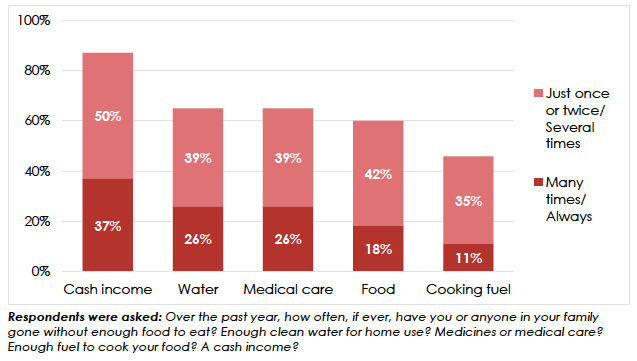
Utilizing a recent Afrobarometer survey, the Ethiopian Policy Institute (EPI) comprehensively outlines the extent to which Abiynomics has mired Ethiopians in poverty and discontent. As illustrated in Figure 1 and Figure 2 below, among the principal reasons for discontent are mismanagement of the economy and the inability of citizen to meet their basic needs, including food, water, and shelter. For example, the vast majority of citizens lack basic necessities, including cash income (87%), water (65%), medical care (65%), food (60%), and cooking oil (46%) (Figure 2).
Figure 1: Evaluations of Government Economic Performance in Ethiopia (2023)
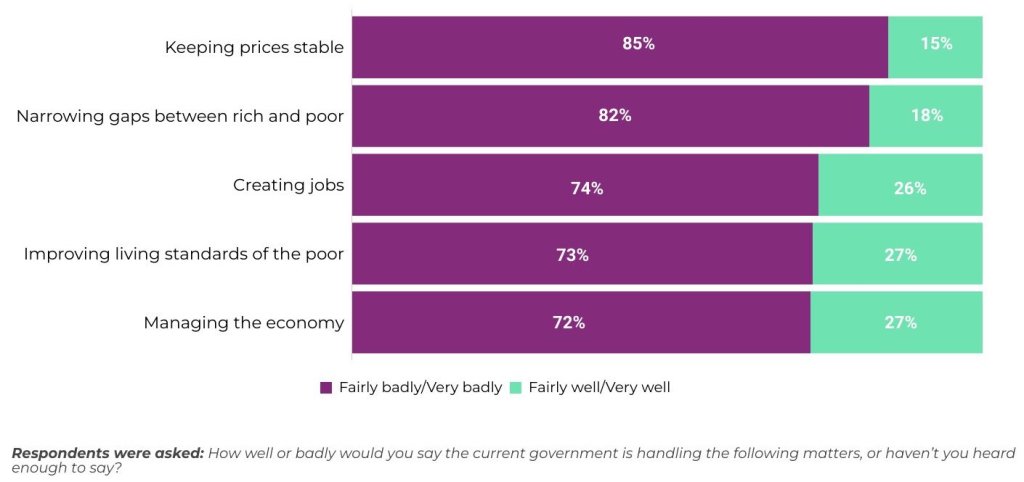
Figure 2: Lack of Basic Necessities in Ethiopia (2023)
Abiy’s “3 Hs”
More broadly, in his unintelligible rant, Abiy confuses cause and effect. His so-called “3 Hs” are effects, or outcomes, that emanate from sound public policies that address the root causes of discontent, namely the lack of: peace, security, justice, the rule of law, health, education, food security, etc. In this regard, his beleaguered regime has demonstrably shown that it is incapable of ensuring basic needs and addressing the root causes devastating the lives and livelihoods of citizens; yet ironically, Abiy claims outcomes such as “happiness, harmony, and human excellence.”
Of course, among the many contradictions in his statement is that food security is a prerequisite for attaining his so-called “3 Hs”. And food and nutrition are directly related to health outcomes, educational outcomes, and human capital development—what Abiy terms “human excellence.”
Concluding Remarks
Abiy’s latest nonsensical statement has been received with a combination of shock and amusement by the Ethiopian public. For the Ethiopian public, what is abundantly clear is that Abiy engages in and thrives on unintelligible, non-tangible, and unfounded political rhetoric and sloganeering. Ethiopians must move on from such vacuous, cruel, and deceitful “leadership”—the sooner the better.
About the Author: Biruk Haregu is a researcher, PhD candidate, and graduate research assistant. His research focuses on the political economy of development in Ethiopia and Africa, international development policy, manufacturing policy, agricultural policy, food security, and the impacts of climate change in developing countries. Prior to his current studies, Biruk worked with the UN Economic Commission for Africa, contributing to key economic and environmental policy initiatives. He can be reached via X: @BirukHaregu
Editor’s Note: The views expressed in commentary and opinion articles published by The Ethiopian Policy Institute (EPI) are those of the author and do not necessarily represent the perspectives of EPI and its editorial team. The publication of any commentary and opinion piece does not imply endorsement by EPI.
We welcome your feedback and reflections, please share them at: ethiopolicyinstitute@gmail.com or via X: @EthiopianPolicy.



 Ethiopian Policy Institute