

In Ethiopia, Abiy Ahmed Ali has once again made headlines for all the wrong reasons. In yet another meandering and bizarre speech to loyalists, Abiy made the stunning claim that the slew of urban construction projects that his regime is undertaking, known as “corridor development”, is being developed for, and will be evaluated by, Ethiopians in 26 years. According to Abiy, “What matters is the generation 26 years from now. The generation that will love and promote their country. Not this generation. Our job is to create new generations that will love and support our work.”
In other words, the suffering, injustice, and discontent of citizens today, at the hands of his fascistic regime, is justifiable. To Abiy, the lives and livelihoods of citizens today is of no value. What matters are those that he aims to indoctrinate, manipulate, and subjugate in the years to come.
Notwithstanding the totalitarian nature of his absurd statement, ironically, Abiy claims to be a democratically elected leader with a popular mandate; while at the same time, ostracizing the citizens that presumably put him in office—claiming that their perspectives on socioeconomic developments that impact their lives and livelihoods are immaterial and inconsequential. The question is: What does that make him?
Growing Despair and Discontent in Abiy’s Ethiopia
In Abiy’s Ethiopia, the combination of proliferating armed conflicts, severe economic hardship, lawlessness and criminality have led to a precipitous increase in despair and discontent. Rather than address these underlying issues, Abiy engages in deflection, blame, deception, co-option, and cruelty. All key elements of his modus operandi.
One of the reasons for rising discontent is the economy. Abiy—who possesses neither an educational nor professional background in economics—has completely mismanaged the Ethiopian economy. After squandering Ethiopia’s limited foreign exchange earnings on civil wars and unproductive vanity projects, as opposed to investing in productive sectors such as manufacturing and industry, Abiy was forced to agree to an IMF structural adjustment program in July 2024. Two short months later, Ethiopians are dealing with a 120% depreciation of the currency, grappling with exorbitant inflation and a cost-of-living crisis, dramatically increasing levels of abject poverty (72% of the populations or 86 of 120 million people), and generally expressing widespread economic despair and discontent.
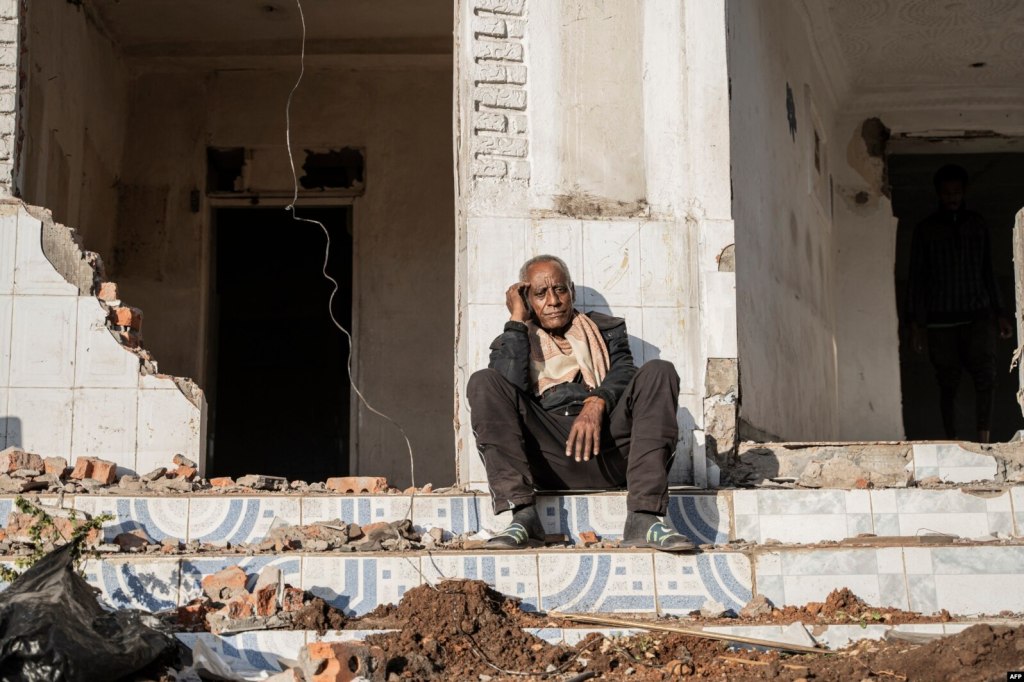
Second, compounding the economic hardship, the Abiy regime has engaged in the wholesale demolition of homes and small and medium-sized enterprises (SMEs) in the capital city, Addis Ababa, and its environs. The Ethiopian Human Rights Commission (EHRC) has called these acts “illegal” and a “breach of human rights law.” Nonetheless, Abiy has moved forward with the demolitions under the pretext of “development.” However, neither economic theory nor data support his argument.
SMEs, which are the backbone of the Ethiopian economy, and the homes of citizens are being destroyed to create bike lanes, plant trees, install fountains, and hang decorative lighting around the city—economically unproductive undertakings. Simultaneously, as a component of the so-called “corridor development”, mass surveillance systems are being installed throughout the capital, including 450 surveillance poles equipped with screens and security cameras.
Fundamentally, Abiy’s vanity projects are not first-order problems for Ethiopia. What Ethiopia requires are investments that create employment opportunities, generate incomes, and develop human capital. Not only do Abiy’s vanity projects fail to advance these goals, they actually undermine them, as they dispossess and deprive citizens of their homes, lives, and livelihoods. Consequently, rather than advancing socioeconomic development, what the Abiy regime is engaged in expropriation, the wholesale transfer of wealth, and demographic engineering in Addis Ababa and its environs.
Third, another underlying reason for the rise of despair and discontent is the proliferation of criminality and lawlessness. In recent months, the rise of abductions for ransom, often sanctioned by regime officials, has shaken Ethiopia. For example, widely circulating and alarming reports indicate that in the Oromia region, young men are being abducted for forced conscription by the regional security apparatus. These young men are held until their families pay significant ransom for their release. If no payment is received, they are given brief military training and sent to the Amhara region to fight in Abiy’s war of aggression on Amhara. Many young men have been captured in combat and admitted to this horrifying scheme of the Abiy regime.
The combination of increasing abductions for ransom and forcible conscription has led to mass fear, despair, and discontent among the citizenry, particularly in the Oromia region. This issue is emblematic of the lawlessness and criminality proliferating in Abiy’s Ethiopia, which in addition to abductions for ransom and forced conscriptions, includes public sector corruption and illicit mining and financial flows.
Finally, in his meandering and disingenuous speech, Abiy went on to lash out at the Ethiopian Diaspora that are raising awareness about his poor governance and the myriad challenges facing Ethiopia and its citizens. In this regard, Abiy states: “those that do not know [Addis Ababa], sitting in comfort wherever they live, they are the ones criticizing us. It is those sitting in Washington D.C. that critique us about developments in our own city.”
Of course, what Abiy conveniently neglects to mention is the fact that citizens in Addis Ababa and throughout Ethiopia are indeed criticizing his vanity projects—citizens whose perspectives and opinions he claimed were “inconsequential”. Citizens being forcibly displaced from their homes. Citizens whose lives and livelihoods are being shattered by his economically unproductive vanity projects. Citizens who are being forced into conscription. Citizens that are being jailed, exiled, or murdered in mass for critiquing his misplaced policy priorities and zero-sum approach to governance.
As Abiy terrorizes—imprisons, exiles, and kills—citizens for expressing their perspectives, opinions, and discontent, he claims it is those in Washington D.C. that are the problem. Such is the state of the increasingly Orwellian and Totalitarian regime of Abiy Ahmed Ali.



 Ethiopian Policy Institute