
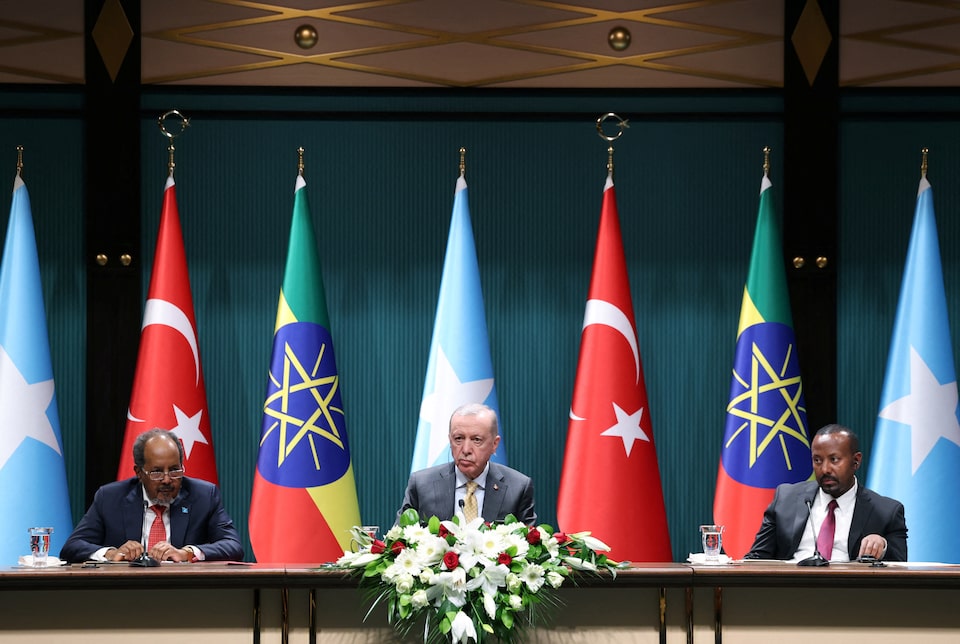
Türkiye has ostensibly brokered a diplomatic agreement between Ethiopia and Somalia, potentially ending months of escalatory rhetoric, rising tensions, and a diplomatic and military standoff between the two Horn of Africa neighbors.
Since January 1, 2024, Ethiopia and Somalia have been at loggerheads, when Abiy Ahmed of Ethiopia signed a Memorandum of Understanding (MoU) with Muse Bihi of Somaliland — the self-declared breakaway region of Somalia. Presumably, the MoU would provide Ethiopia a stretch of coastline to develop a port and naval base; and in exchange, Somaliland would gain diplomatic recognition from Ethiopia.
The MoU was viewed by Somalia — which considers Somaliland as part of its territory — as a breach of its sovereignty and territorial integrity. The MoU was also widely recognized by the international community as a breach of international law, the United Nations Charter, and the African Union Charter.
More broadly, the secretive, deceptive, and destabilizing nature of the MoU — which raised concerns of renewed instability and conflict in the Horn of Africa — is emblematic of Abiy’s approach to foreign policy.
After eight months of mediation by Türkiye, a diplomatic agreement may have finally been reached. In a joint press conference facilitated by Türkiye’s Recep Tayyip Erdoğan, Abiy Ahmed and Hassan Sheikh Mohamud of Somalia announced that they have “reached a compromise and joint declaration” that aims to: cease differences, commit to addressing misunderstandings, and ensure regional peace and security.
More specifically, according to the joint Ankara Declaration, Ethiopia and Somalia commit to the following:
- Reaffirm their respect and commitment to each other’s sovereignty, unity, independence, and territorial integrity, in accordance with international law, the United Nations Charter, and the African Union Constitutive Act.
- “Agree to forgo and leave behind differences and contentious issues and forge ahead in a cooperative manner to pursue shared prosperity.” A subtle and diplomatic reference to the contentious MoU that precipitated the diplomatic row.
- Agree to work together to finalize mutually beneficial commercial arrangements through bilateral agreements, including contract, lease, and similar modalities, which will “allow the Federal Democratic Republic of Ethiopia to enjoy reliable, secure, and sustainable access to and from the sea, under the sovereign authority of the Federal Republic of Somalia.”
To this end, Ethiopia and Somalia committed to commence “technical negotiations” by the end of February 2025, to be concluded within four months, with facilitation and support provided by Türkiye.
Notwithstanding the potential benefits of this agreement, including the de-escalation of tensions and diplomatic off-ramp it provides Abiy, much remains to be seen. In the Horn of Africa, where regional dynamics are characterized by rapidly shifting alliances — and in particular, where the inexperienced Abiy has consistently demonstrated a propensity for an erratic, deceptive, and destabilizing modus operandi — it will be critically important to follow the extent to which this ostensible diplomatic agreement holds, and to what extent and how quickly it is actually implemented.



 Ethiopian Policy Institute