
The Office of the U.S. Trade Representative has announced that Ethiopia will remain ineligible for the African Growth and Opportunities Act (AGOA) — a preferential trade arrangement granting countries in sub-Saharan Africa with duty-free access to the U.S. market.
AGOA was passed by the 106th U.S. Congress (1999-2001) and signed into law by President Bill Clinton in May 2000. Since then, AGOA has been extended and expanded by both Democratic and Republican administrations, and remains the cornerstone of U.S. commercial engagement with Africa.
Ethiopia’s Removal from AGOA
On September 17, 2021, President Joe Biden signed Executive Order 14046, “to deal with the situation in and in relation to northern Ethiopia, which has been marked by activities that threaten the peace, security, and stability of Ethiopia and the greater Horn of Africa region … and constitutes an unusual and extraordinary threat to the national security and foreign policy of the United States.”
Executive Order (EO) 14046 was the U.S.’s response to Ethiopia’s devastating civil war, launched on November 3, 2020, which was characterized by war crimes and gross human rights violations. In essence, EO 14046 deemed Ethiopia ineligible for AGOA privileges, effective January 1, 2022.
In extending Ethiopia’s AGOA ineligibility for 2025, the U.S. Trade Representative cited the ongoing “gross violations of internationally recognized human rights” being perpetrated by the Abiy Ahmed regime. In addition to the two-year civil war in northern Ethiopia (2020-2022), the Abiy regime is now conducting a war of aggression on Ethiopia’s Amhara region — replete with war crimes and gross human rights violations, including extrajudicial killings and drone strikes targeting civilians and civilian infrastructure.
Impact on Manufacturing
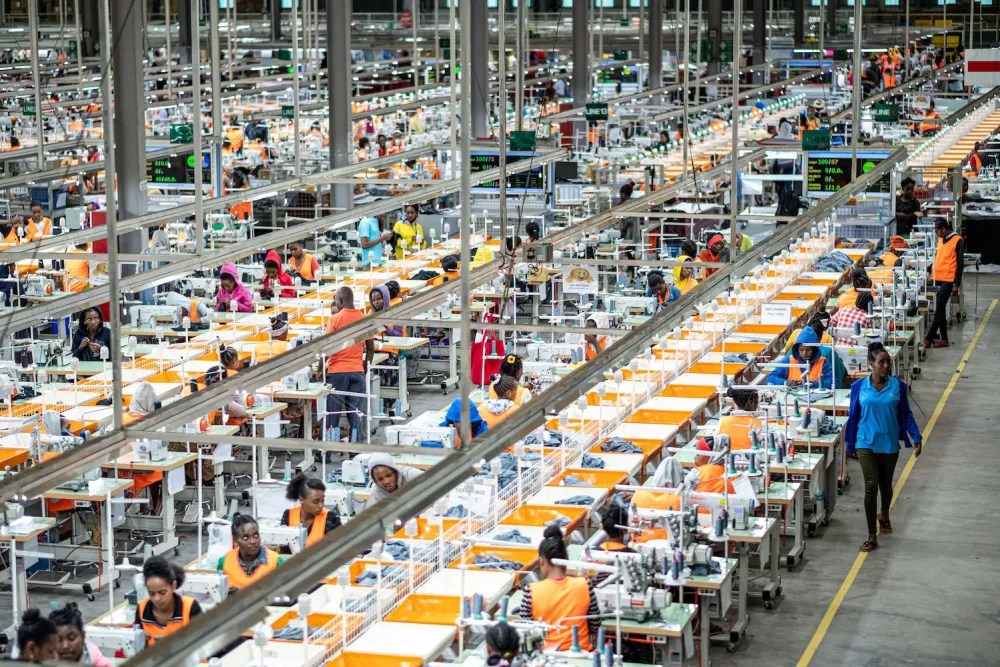
Ethiopia’s removal from AGOA has adversely affected Ethiopia’s nascent yet once promising manufacturing sector. Prior to its removal, Ethiopia was viewed as a poster child for effective utilization of AGOA. Since 2001, when AGOA went into effect, Ethiopia’s exports to the U.S. — principally apparel, textiles, leather products, and horticulture — have increased by 150%. And between 2001-2020, Ethiopia’s exports under AGOA jumped from $28m to $525m. Much of these gains were made after 2012, when Ethiopia implemented an effective industrial parks program aimed at developing light manufacturing capacity through the utilization of AGOA.
Ethiopia’s emerging manufacturing sector showed great promise, according to a World Bank report on Ethiopia’s manufacturing sector and industrial parks program. Between 2012-2017, manufacturing productivity, manufacturing foreign direct investment (FDI), employment in manufacturing, and manufacturing exports were consistently increasing.
For instance, in 2016, FDI inflow was $4.2 billion of which $3.7 billion was manufacturing FDI. Similarly, manufacturing value-added increased from $1.5 billion in 2012 to $5 billion in 2017. At the same time, during this period, notable clothing manufacturers such Calvin Klein, Tommy Hilfiger, IZOD, and Van Heusen began investing in Ethiopia — creating employment opportunities for an estimated 200,000 Ethiopians, and facilitating skill and technology transfers.
Since Ethiopia’s removal from AGOA, however, international manufacturers have left Ethiopia for neighboring countries, while hundreds of domestic firms have shuttered their operations. In addition to AGOA ineligibility, exorbitant inflation, a chronic foreign exchange shortage, and a cost of living crisis have devastated Ethiopia’s debt-laden economy. Consequently, manufacturing FDI, employment in manufacturing, and manufacturing productivity and exports have all plummeted.
Although the Abiy regime has lobbied for AGOA reinstatement, its lobbying efforts have proven unsuccessful. Considering the regime’s ongoing war on the Amhara region — characterized by war crimes and gross human rights violations — the request for reinstatement was always impractical.
Concluding Remarks
The importance of AGOA, in providing manufacturers in Ethiopia with tariff-free access to the U.S. market and creating employment opportunities for Ethiopians, cannot be overstated. Unfortunately, the Abiy regime’s ceaseless military adventurism, war crimes, and gross human rights violations — conducted at the expense of Ethiopia’s socioeconomic growth and development, including its once promising manufacturing sector — has proven to be a strategic blunder.



 Ethiopian Policy Institute