
The Trump administration, through a presidential Executive Order signed on January 20, 2025, has prohibited all new programming and issued a broad “stop-work” order on existing U.S. foreign assistance programs administered through the United States Agency for International Development (USAID).
USAID — established when President John F. Kennedy signed the Foreign Assistance Act into law in 1961 — provides development and humanitarian assistance around the world. In so doing, the U.S. effectively deploys soft power as a means of advancing its interests and values abroad, while countering threats posed by Russia and China — who compete with the U.S. for soft power supremacy.
The U.S. allocates less than 1% of its federal budget to foreign assistance. In 2023, USAID distributed $43.8 billion of the $71.9 billion the U.S. allocated toward foreign assistance programs, making it the world’s single biggest aid agency — providing assistance in areas such as health (maternal and child health, malaria, TB, HIV/AIDs drugs); agriculture (emergency food aid); and education (teacher training programs), among others.
Figure 1: U.S. Foreign Assistance by Category (2023)

Top Recipients of U.S. Assistance
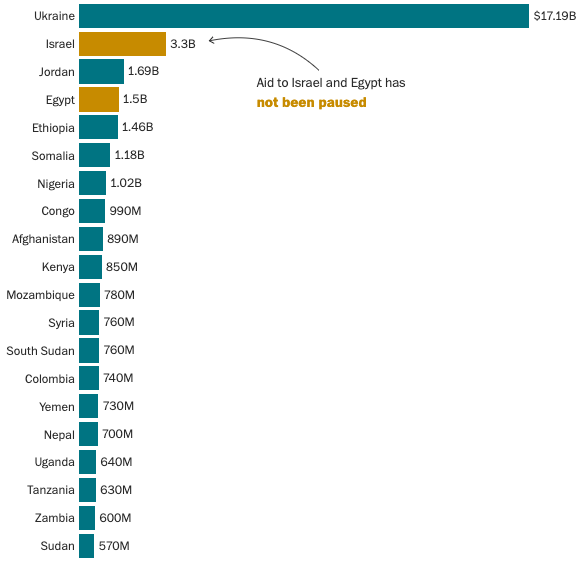
The suspension of USAID will have ramifications for countries such as Ethiopia that receive significant financial support from the organization. Over the past five years, countries in sub-Saharan Africa have accounted for more than a third of U.S. foreign assistance funding.
In 2023, ten countries in Africa received more than $10 billion in U.S. assistance (Figure 2). The funding provides access to emergency food assistance, life-saving vaccines, and security programs across the continent.
Figure 2: Top 20 Recipients of U.S. Assistance (Security, Development, and Humanitarian Aid) (2023)
USAID in Ethiopia
USAID is the largest provider of foreign assistance in Ethiopia. Depending on the year, Ethiopia receives between $1.5 billion to $2 billion annually in development assistance from USAID. This assistance impacts development initiatives across health, education, agriculture, and emergency humanitarian assistance.
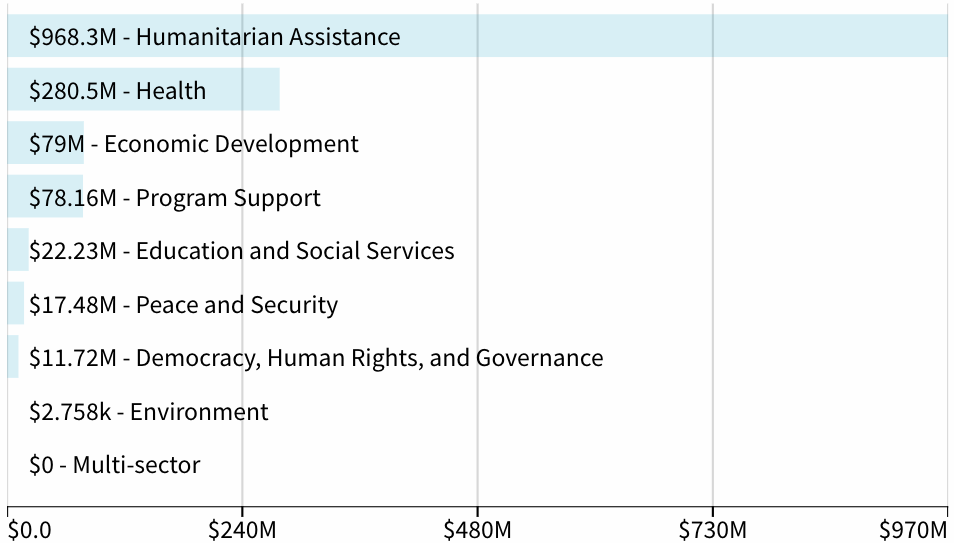
For Ethiopia, the suspension of USAID puts at risk an estimated $968 million allocated for humanitarian assistance, $280 million allocated for basic health programs, $118 million for food security, $79 million for economic development, and $63 million for agriculture programs, among others — and with over 20 million Ethiopians in need of humanitarian assistance, these disruptions are likely to exacerbate poverty, food insecurity, and displacement.
Figure 3: U.S. Foreign Assistance to Ethiopia by Sector (2023)
Source: ForeignAssistance.gov
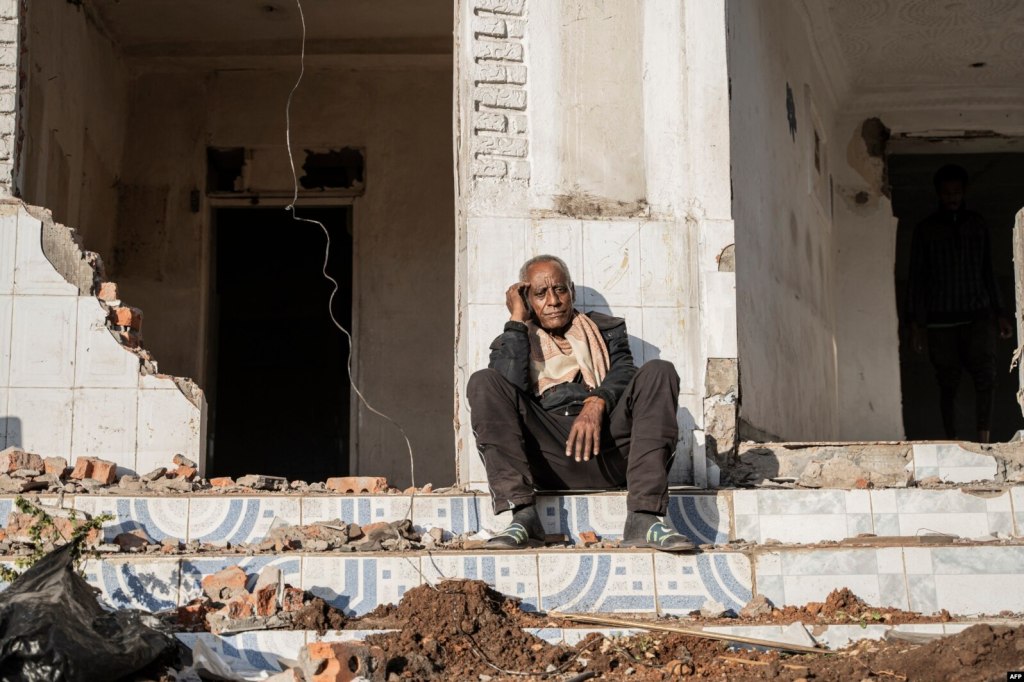
Just days after the suspension of USAID, repercussions are already being felt. Ethiopia’s Ministry of Health has terminated the contracts of 5,000 health care employees hired under projects funded by USAID and the Center for Disease Control (CDC). Similarly, Action Against Hunger, which provides food aid to malnourished children in refugee camps has discontinued its operations. More broadly, civil society organizations are at risk of shuttering their operations, firing their employees, and discontinuing humanitarian operations, according to the Ethiopian Civil Society Organizations Council.
The suspension of USAID arrives at a time when Ethiopia is grappling with a confluence of socioeconomic challenges that have drastically increased the need for humanitarian assistance.
In the last six years, under the Abiy Ahmed regime, due to poor governance, economic mismanagement, and the proliferation of armed conflict:
- 72% of the population is mired in multidimensional poverty with an additional 18% on the cusp of multidimensional poverty.
- Poverty is rapidly rising in every region of the country.
- Over 20 million people need emergency humanitarian aid.
- 5.4 of 6 million citizens in Tigray region need emergency food aid.
- Acute food insecurity and famine afflicts over 10,000 citizens in Bugna woreda, Amhara region.
- 5.1 million Internally Displaced Persons need humanitarian assistance, including food, shelter, and hygienic services.
- 5,500 schools have closed due to conflict and instability, of which 4,178 are in Amhara region.
- More than 9 million school-aged children are currently out of school. In Amhara region, only 2.3 million students are enrolled for the current academic year out of 7 million school-aged children.
In sum, there is significant and urgent need for humanitarian assistance in Ethiopia, and the suspension of USAID will adversely affect millions of vulnerable people desperately in need of lifesaving assistance.
The Abiy Regime’s Misguided Public Policy
While there is significant and urgent need for humanitarian assistance in Ethiopia, the Abiy regime has failed to deliver the needed assistance to the most vulnerable segments of Ethiopia’s population. According to a recent International Monetary Fund evaluation, the Abiy regime has failed to adequately fund and strengthen the social safety net program on which the most vulnerable depend.
Rather than scale-up pro-poor spending on the social safety net, education, and health, or invest in bolstering productive capacities in manufacturing and industry, the Abiy regime is spending limited resources on unproductive vanity projects. These projects include Abiy’s exorbitant $15 billion pharaonic palace, $4 billion palace for the President of Oromia region, and numerous resorts and lodges that are being built with illicit funds from the UAE and without oversight from the Ethiopian Parliament.
Comparatively, between 2020-24, investments in human capital and productive capacities have declined precipitously. For instance, the education budget declined from 123 billion Birr to 55.8 billion Birr — a 55% reduction. The health budget declined, from 51 billion Birr to 22.6 billion Birr — a 56% reduction. While military spending increased from 16.5 billion Birr to 65.7 billion Birr — a staggering 298% increase.
In short, while the socioeconomic needs of Ethiopians continue to grow amid conflict, poverty, and inequality, the misguided policy priorities of the Abiy regime have not enabled citizens to meet their basic needs. Rather, the Abiy regime has exacerbated the needs of the least well-off in Ethiopian society.
In this context, the suspension of USAID and its programs will have dire consequences in Ethiopia. Unfortunately, to date, the Abiy regime has yet to address the suspension of USAID, outline how it plans to respond and support vulnerable citizens.

 Ethiopian Policy Institute