
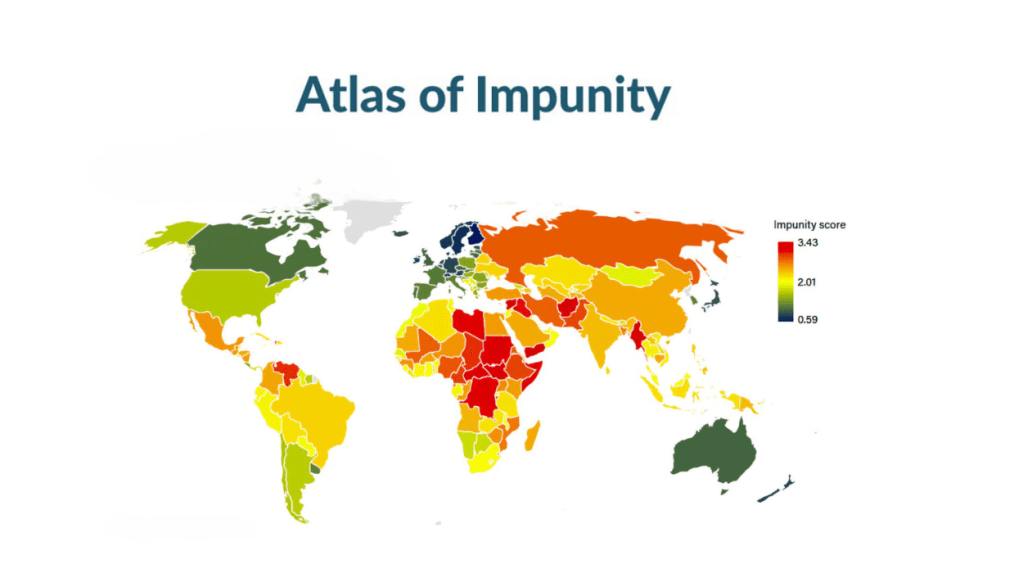
Impunity for crimes committed by the most powerful actors in Ethiopia is getting worse, according to a report by the Eurasia Group titled Atlas of Impunity 2024: A Peoples Perspective, released on February 14, 2025.
Impunity is the exercise of power without accountability; or put differently, committing crimes without punishment. While the chief perpetrators of impunity are often a country’s most powerful actors, its victims are generally ordinary people.
The Atlas of Impunity is a comprehensive tool designed to track the abuse of power across five key societal dimensions: 1) unaccountable governance; 2) abuse of human rights; 3) economic exploitation; 4) conflict and violence; and 5) environmental degradation. Based on these five dimensions, the index provides an overall impunity score on a scale of 0 to 5, with greater values corresponding to a higher degree of impunity — countries where people have the most impunity score closer to 5.
In 2024, the five countries with the least impunity; and thus, greatest level of accountability are: Finland (0.59); Denmark (0.63); Sweden (0.70); Switzerland (0.71); and Norway (0.74). While, the countries experiencing the most impunity and unaccountability are: Syria (3.43); Yemen (3.41); Myanmar (3.39); Afghanistan (3.38); and South Sudan (3.33).
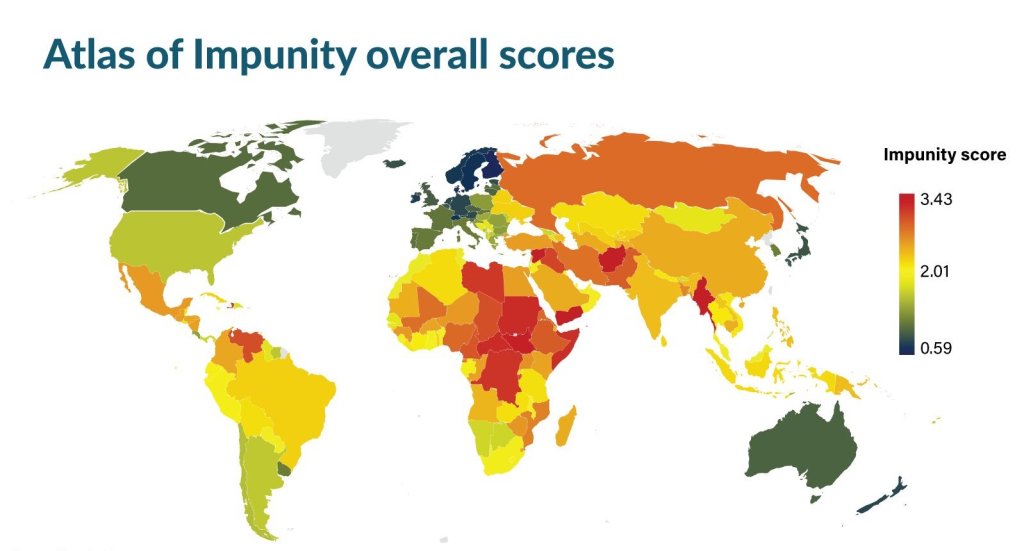
Impunity in Ethiopia
Under the Abiy regime, impunity continues to worsen in Ethiopia – as public sector corruption, war crimes, and gross human rights violations proliferate.
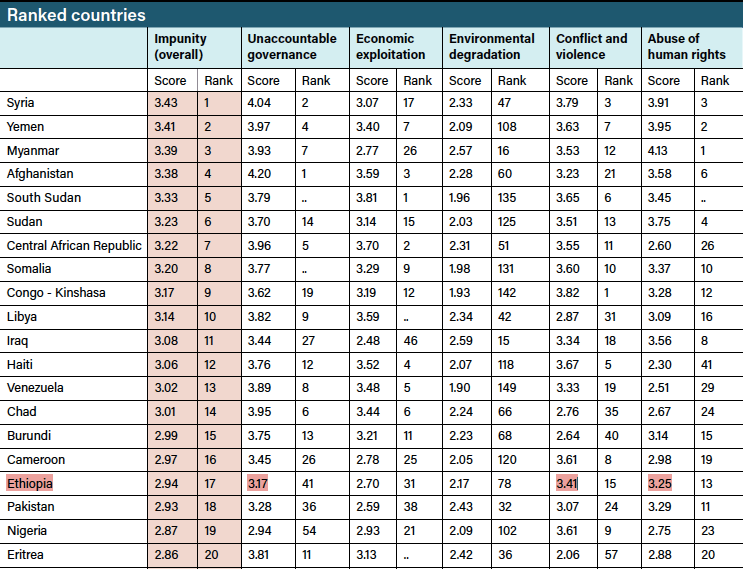
Ethiopia’s overall score of 2.94 out of 5, ranks 17th worst out of 170 countries ranked, or 153rd out of 170 (Figure 1). Ethiopia’s score also falls below the average score of 2.02 out of 5 – with the country’s score declining from last year. Additionally, levels of justice and accountability have consistently eroded for the past five years, according to the the Atlas of Impunity report.
As the table below illustrates, worsening impunity and accountability can be principally attributed to the following three factors: 1) proliferation of conflict and violence (3.41); 2) systemic abuse of human rights (3.35); and 3) unaccountable governance (3.17).
Figure 1: Countries With Highest Degree of Impunity, Ranked 1-20 (2024)
Source: Eurasia Group, The Atlas of Impunity 2024
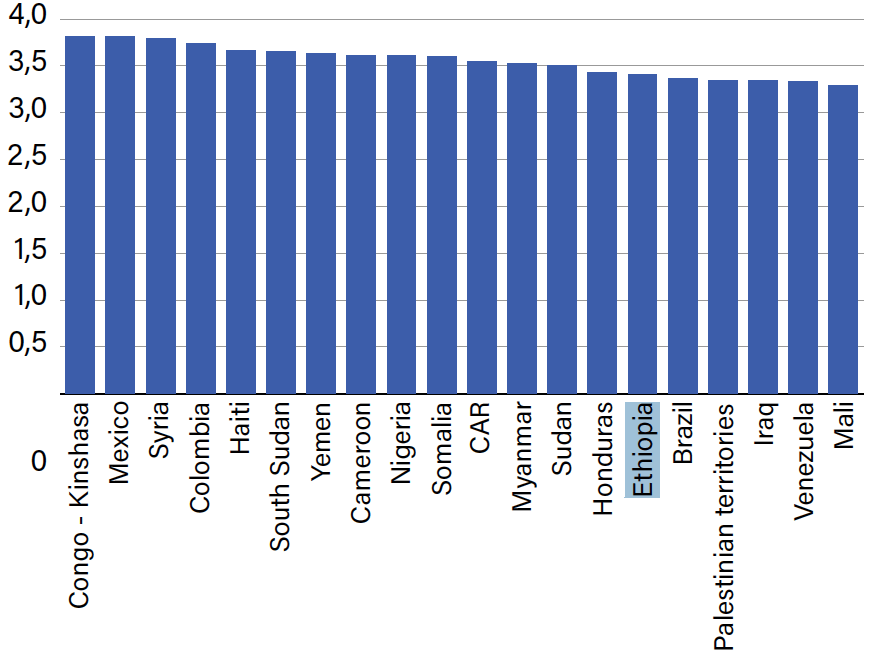
In particular, the ongoing conflicts in Amhara and Oromia regions continue to elevate Ethiopia’s conflict and violence score, which is the country’s worst performing dimension — scoring 3.41 out of 5 (Figure 2).
Conflict and Violence
Since 2020, Ethiopia has been mired in civil war, particularly in the Tigray, Amhara, Afar and Oromia regions — and the full-fledged war in the Amhara region continues to rage with no end in sight. Amidst conflict, the Abiy regime has been implicated in war crimes, including extrajudicial killings, using sexual violence as a weapon of war, and targeting civilians and civilian infrastructure with drone strikes.
There has been little to no accountability for the ongoing systemic human rights violations — as justice continues to elude victims and their families.
Figure 2: Countries with Highest Conflict & Violence Scores (2024)
Source: Eurasia Group, The Atlas of Impunity 2024
Public Sector Corruption and Unaccountable Governance
In addition to conflict and human rights violations, sustained public sector corruption — at the highest level of the regime — continues to undermine the rule of law and accountability in governance. Global indexes, including the corruption perception index and the rule of law index, illustrate that public sector corruption and impunity for corrupt officials is now endemic in Ethiopia. Ethiopia’s rule of law and corruption scores have consistently declined since 2020-21.
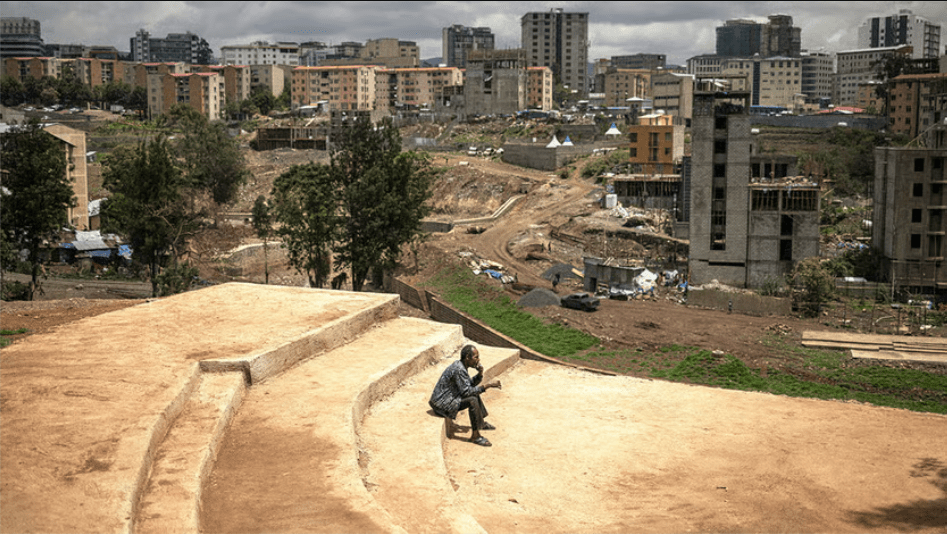
Much of the corruption starts at the very top with Abiy Ahmed, who has brazenly claimed that he is above Parliamentary oversight — as his numerous vanity projects are mired in secrecy. In addition to Abiy’s exorbitant $15 billion pharaonic palace, there is a $4 billion palace for the President of the Oromia region, the so-called “corridor project” in Addis Ababa, and numerous resorts and lodges that are being built with illicit funds from the United Arab Emirates without Parliamentary oversight.
Currently, transparency on the bidding process for government contracts, and oversight mechanisms to minimize corruption and malfeasance, are non-existent. As Abiy stated during an address to the Ethiopian Parliament, no individual — including members of Parliament — should ever ask him about financial flows into Ethiopia, in the billions of dollars, for the vanity projects that he is constructing without oversight. As a consequence, Abiy has prohibited the Office of the Prime Minister from being audited.
In sum, impunity is on the rise in Ethiopia — with impunity and unaccountability starting at the very top of the Abiy regime. This development has facilitated the proliferation of criminality and lawlessness, including public sector corruption, conflict and violence, kidnappings, and abductions for ransom, among others. Ultimately, such a breakdown in justice, accountability, and the rule of law undermine the prospects of socioeconomic growth, development, and transformation.

 Ethiopian Policy Institute