
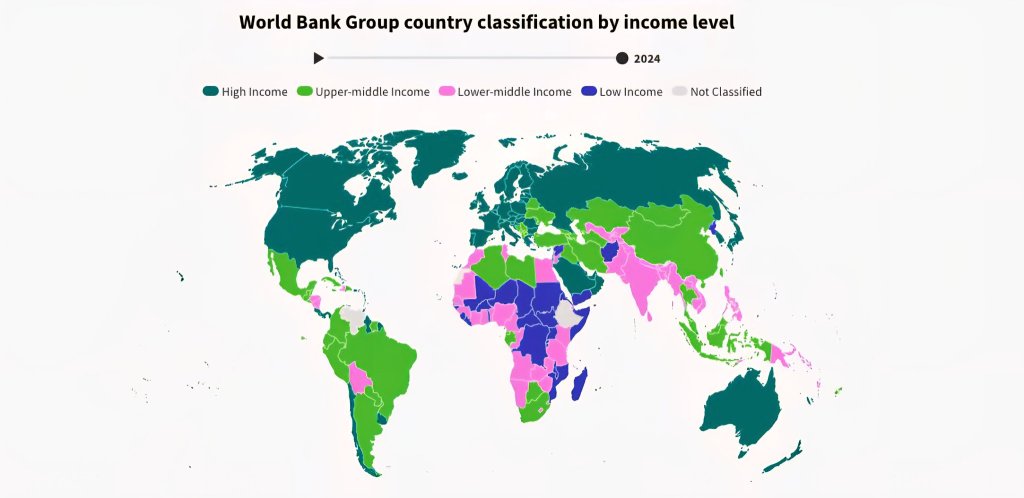
Ethiopia is listed as “unclassified” in the World Bank’s latest income ranking. The “unclassified” designation is a consequence of the lack of reliable economic data, according to the World Bank.
The World Bank’s FY2026 classification (Figure 1), categorizes countries into four income groups—low, lower-middle, upper-middle, and high—based on per capita Gross National Income (GNI) calculated using the World Bank’s Atlas method.
Of the 218 countries included in the classification for FY2026, Ethiopia and Venezuela are the only two countries to receive a designation of “unclassified”.
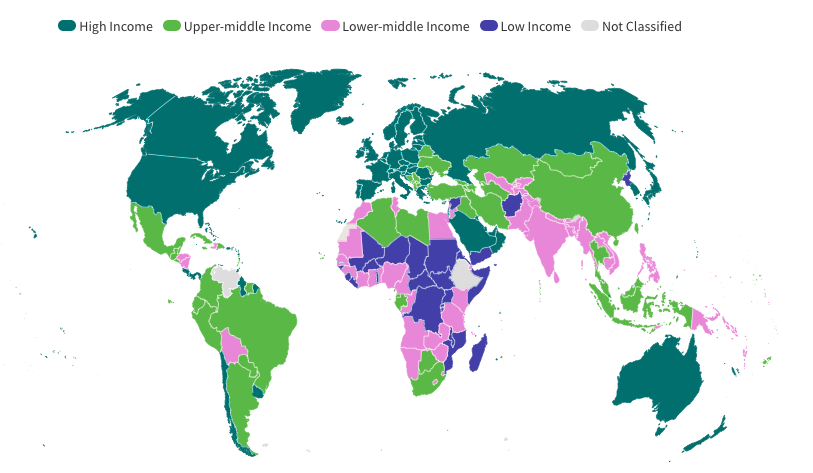
Figure 1: World Bank Group Country Classification by Income Level
Ethiopia’s “unclassified” designation comes at a time when the World Bank and IMF have scaled-up financial support to the country. As a prerequisite for financial support, Ethiopia, under Abiy Ahmed, adopted an IMF Structural Adjustment Program in July 2024 and a wholesale economic liberalization and privatization agenda.
Notwithstanding their financial support, however, by designating Ethiopia as “unclassified”, the World Bank puts into question the quality, accuracy, and reliability of economic data being propagated by the Abiy Ahmed regime.
Lack of Quality, Accurate, and Reliable Economic Statistics
Since 2023, economic statistics has been a point of severe contention in Ethiopia. Statisticians from Ethiopia’s Central Statistics Agency (CSA) have been at loggerheads with the Office of the Prime Minister that has pushed fabricated economic data onto the CSA.
Experts from the CSA have been instructed to certify and publish fabricated economic statistics as official statistics–the directive emanating from the Office of the Prime Minister. Statisticians that refused to accept and publish the fabricated data peddled by the Office of the Prime Minister have been fired and replaced by regime loyalists. As a consequence, in recent years, GDP, GDP growth rate, per capita GDP, inflation, and wheat production data have come under considerable question.
Implications for Ethiopia’s Development Policy
Ethiopia’s Ministry of Planning and Development had long forecasted that the country would attain middle-income status by 2025. However, since Abiy Ahmed assumed power in 2018, the development trajectory of the country has been severely derailed. As a consequence of ongoing armed conflicts, economic mismanagement, and development policy misprioritization, the target of attaining middle-income status by 2025 will go unmet. In 2025, rather than attaining middle-income status, Abiy Ahmed’s Ethiopia received an “unclassified” designation from the World Bank.
Furthermore, in its latest report on “Fragility and Conflict-Afflicted Situations”, the World Bank finds that Ethiopia is one of 39 countries currently afflicted by conflict and instability, which is “driving up extreme poverty, intensifying acute hunger, and pushing key development goals farther out of reach.” Rather than advancing socioeconomic development and moving from low to middle-income status, Ethiopia, under Abiy Ahmed, is “falling deeper into poverty and state fragility”, according to the World Bank report.
Income Classifications
A country’s income classification not only reflects its level of development, but it also has the potential to influence its development trajectory, including eligibility for official development assistance and concessional financing.
In the East Africa region, FY2026 classifications illustrate that Kenya and Tanzania maintained their lower-middle income status, defined by a per capita GNI between $1,136 and $4,465. Djibouti, Eritrea, Somalia, Sudan, and Uganda remain in the low-income category with per capita GNI below $1,135.
Globally, the biggest gains were made by Costa Rica, Cabo Verde, and Samoa. Costa Rica attained high-income status with a per capita GNI of more than $13,935, while Cabo Verde and Samoa attained upper-middle income status with a per capita GNI between $4,496 and $13,935.

 Ethiopian Policy Institute