
By: Kebour Ghenna
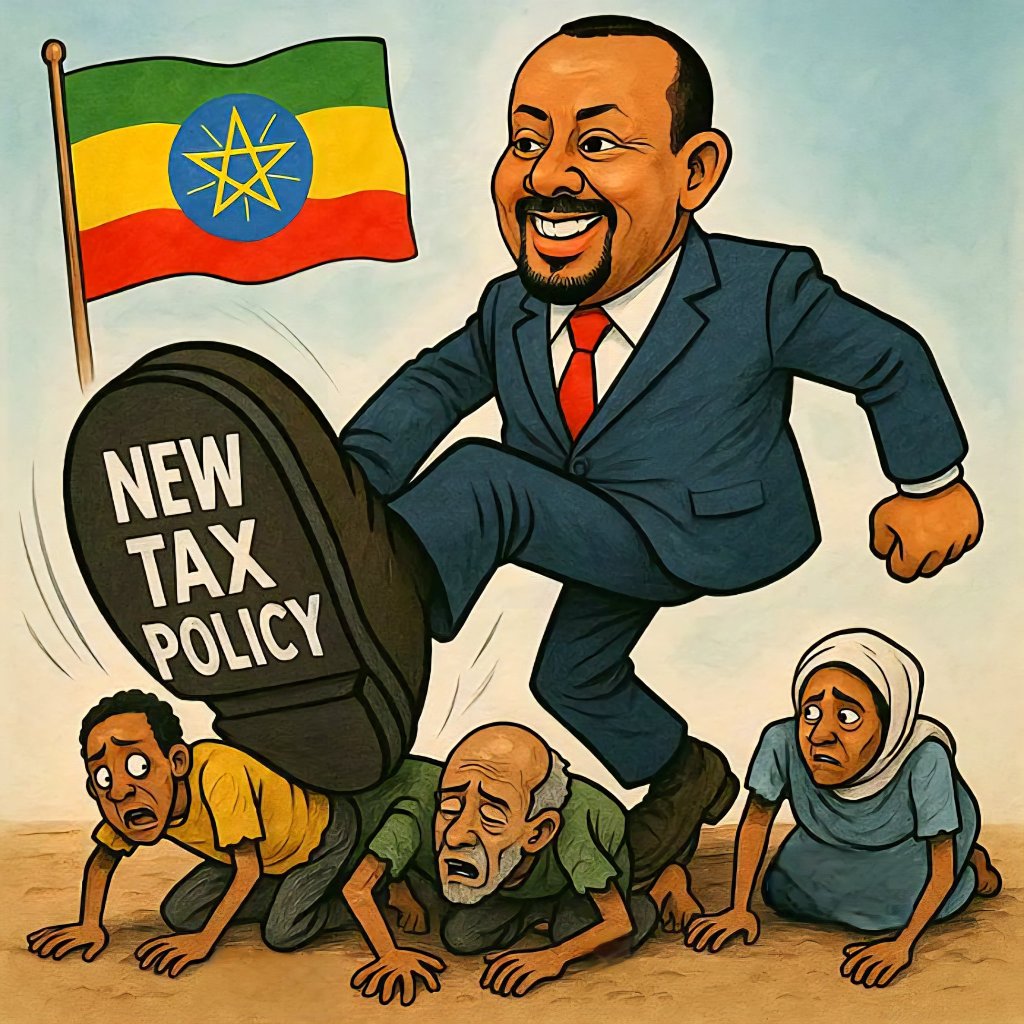
You’ve got to admire the Abiy Ahmed regime. Even in the worst of times, it never runs out of creative ideas for how to squeeze a little more blood from the turnip.
Take the latest “reform” to the income tax law. It sounds innocent enough, a few adjustments to the tax brackets. But under the shiny wrapping is the same old trick: rob the poor to “balance the books.”
Here’s the update. Under the new tax schedule, anyone earning ETB 2,000 or less per month is spared. Those pulling in less than ETB 4,000 pay 15%. If you make less than ETB 7,000? That’s 20%. And so on.
Sounds fair? Maybe, until you realize that at today’s exchange rate, an individual earning ETB 8,000 a month – a sum still taxable – is making barely $2 a day. That’s the UN poverty line. Yes, the Abiy regime, fresh from its budget consultations with the IMF and World Bank, now wants to tax its poorest citizens, those barely able to afford cooking oil, bus fare, school fees, and health services.
They say it’s necessary. That the government can’t “balance its books” otherwise. That this tax burden is essential for growth. But that’s utter nonsense, the kind peddled by accounting wizards who’ve never met a market or a hungry child.
Let’s be clear about one thing. When the government taxes the poorest, it doesn’t collect from “savers” or “speculators.” It collects from people who spend everything they earn. Not on vacations or luxury goods but on food, rent, school fees, and the occasional trip to the clinic. These expenditures don’t disappear into a black hole; they go right back into the economy. They pay the shopkeeper, the minibus driver, the farmer, the tailor — and yes, they pay taxes again in the form of VAT.
The money circulates. It creates jobs. It supports local businesses. It stimulates demand that thing economists pretend to care about. And it even raises tax revenue indirectly.
So why take that money away?
Because neoliberal myth-makers, the budget balancers and austerity disciples, have convinced governments that taxing the poor is “fiscal responsibility.” That the only way to be taken seriously in Washington or Paris is to look serious, while holding the poor upside down and shaking them for loose change.
Taxing those who have no cushion, no margin, no savings, is not responsible. It’s reckless. And it’s bad economics.
If you want to grow the economy, you let the poor breathe. You raise the tax threshold to reflect a livable income, not one anchored in 1994. You cut taxes on wages under ETB 8,000, and maybe even subsidize essentials for those living under $2 a day.
You tax where the money is. You go after monopolies. You curb unnecessary perks for top officials. You plug the billion-birr leakages in procurement. You make the richest pay their fair share.
And while you’re at it, you create a coherent, productive investment plan, one that actually supports exports, manufacturing, and jobs. That helps bring down inflation not by strangling demand, but by boosting local supply and reducing import dependence.
There are always alternatives. The decision to suppress income, to tax the bottom while coddling the top, is a political choice, not an economic necessity.
So the next time someone says Ethiopia needs to “tighten its belt” or “balance the budget,” ask them why the burden always falls on the smallest shoulders. Because the real task is not to squeeze more tax from the poor, it’s to broaden the economic pie. That means investing in people, in productivity, and in policies that allow the lowest earners to spend, grow, and thrive.
***
About the Author: Kebour Ghenna is Executive Director of the Pan African Chamber of Commerce and Industry (PACCI), a leading organization representing the interests of business and trade associations in Africa, and the President of Initiative Africa, an education focused NGO operating in Ethiopia. A post graduate of the State University of New York at Stony Brook, he is a regular contributor to Capital, a weekly newspaper he established in Ethiopia in 1996.
 Ethiopian Policy Institute