
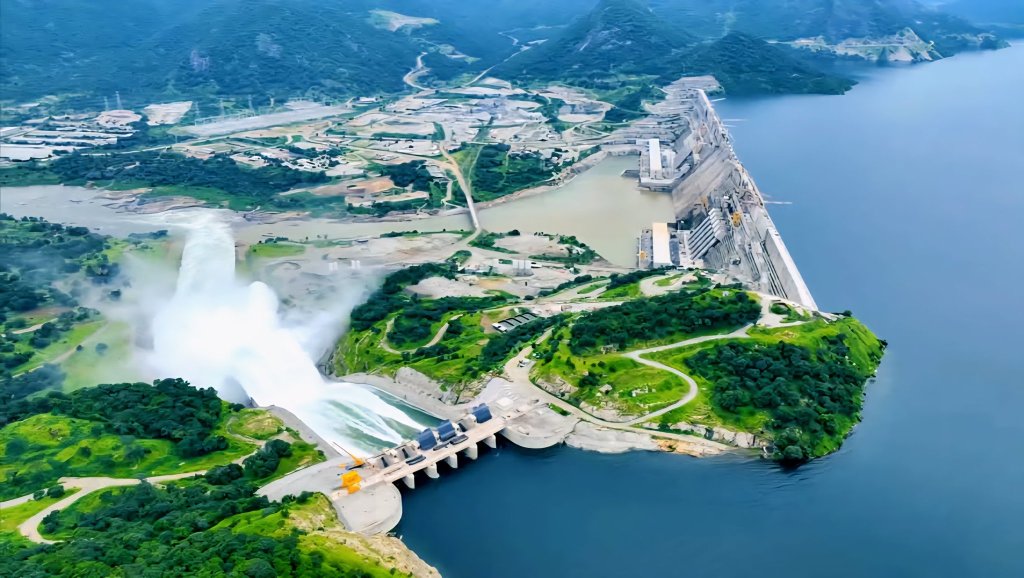
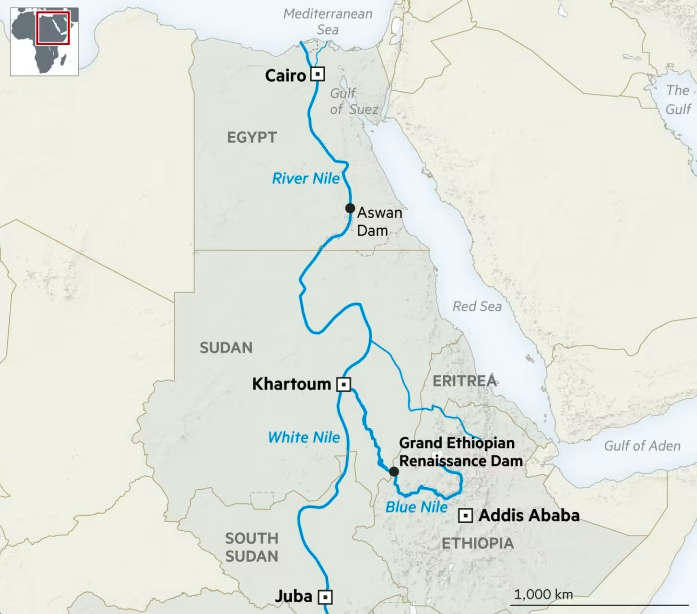
In recent weeks, President of the United States (U.S.) Donald Trump has been publicly stating that the U.S. funded Ethiopia’s flagship development project — the Grand Ethiopian Renaissance Dam (GERD). Trump also erroneously asserts that the GERD “will cut-off the flow of the Nile river” to downstream countries, namely Egypt and Sudan. Moreover, Trump claims: “we now have that issue solved”, without specifying who “solved” the issue and how.
Trump’s claims run contrary to the public record. The GERD is a national project self-financed by Ethiopians through domestic revenue, government bonds, and significant financial contributions from citizens and the diaspora.
In 2020, during his first administration, rather than fund the GERD, Trump suspended $130 million in development assistance to Ethiopia. The goal being to pressure Ethiopia to sign a legally binding agreement with Egypt on the filling and operation of the GERD. This strategy failed as negotiations ended without an agreement.
In 2021, the Biden administration would lift the restrictions and begin to release development assistance to Ethiopia, stating that U.S. aid would no longer be linked to the Ethiopia-Egypt dam dispute. In addition, in 2024, Ethiopia agreed to an IMF program that released $3.4 billion in loans to the country. The agreement also unlocked development assistance from the World Bank potentially worth billions of dollars. Perhaps it is this releasing of development assistance to Ethiopia that Trump is intentionally mischaracterizing as the “U.S. funding the dam.”
Nevertheless, in his second administration, Trump once again appears to have taken the side of, and has become an advocate for Egypt — and his “favorite dictator” — vis-à-vis Ethiopia and the GERD.
In light of these troubling developments, Ethiopian authorities have remained curiously silent. There have not been any public statements, written or verbal, challenging the veracity of, and condemning, the highly controversial statements.
This begs the questions: why is the Abiy regime conspicuously silent at a time when Ethiopia’s national interests are being undermined? Why have the Ministry of Foreign Affairs and the Office of the Prime Minister not issued an official statement? Why have they chosen silence rather than setting the record straight and reassuring the Ethiopian public?
To unpack and shed light on these questions, it is critically important to consider Abiy’s approach to foreign policy, or Abiy’s foreign policy doctrine.
The Abiy Doctrine: Ethiopia’s Foreign Policy Under Abiy Ahmed
The Abiy Doctrine can be succinctly summarized as the de-institutionalization — deliberate weakening and hollowing-out of government institutions — and personalization of Ethiopia’s foreign policy to advance Abiy’s political objectives, namely the consolidation, retention, and wielding of absolute power, at all costs. Put differently, the Abiy Doctrine has shifted Ethiopia’s foreign policy bureaucracy into Abiy’s hands — and away from Ethiopia’s Ministry of Foreign Affairs — and in doing so, serving to advance his personal and political agendas rather than the national security and economic interests of Ethiopia.
Since assuming power in 2018, rather than advance Ethiopia’s national interests, Abiy has consistently undermined it — often to advance his own personal and political interests. For example, Abiy’s secret dealings with the United Arab Emirates (UAE), the short-lived rapprochement with Eritrea and Somalia, the Memorandum of Understanding (MoU) fiasco with Somaliland, and Ethiopia’s suspension from the African Growth and Opportunities Act (AGOA) – advanced Abiy’s short-term political interests, while undermining Ethiopia’s national interests.
In short, the Abiy Doctrine has led to a series of diplomatic miscalculations and blunders, diplomatic isolation, and declining credibility and foreign direct investment. Consequently, the adverse effects of the Abiy Doctrine pose significant risks to Ethiopia’s stability, national security, and economic interests – and this now appears to be on clear display with Abiy’s handling of the GERD amid Trump’s verbal onslaught.
As a consequence of the de-institutionalization of Ethiopia’s foreign policy bureaucracy, the country’s once robust and effective Ministry of Foreign Affairs has been rendered ineffectual — even at a time when national interests are directly under attack. Therefore, unsurprisingly, the Ministry of Foreign Affairs, lacking both authority and capacity, has remained silent as Trump continues to undermine the GERD.
At the same time, as a consequence of the personalized and secretive nature of Abiy’s foreign policy process, Abiy has chosen: 1) not to be transparent; 2) not to officially address the nefarious claims directed at the GERD and Ethiopia’s national interest; and 3) not to deliver a public statement reassuring the Ethiopian public on a matter of national significance.
Strategic Silence or an Attempt at Galvanizing Nationalism?
Could Abiy be choosing to remain silent as a matter of strategy? Perhaps he doesn’t want to anger Trump – and deal with Trump’s fury, incessant attacks, and a potential tariff decree? Or perhaps he calculates that construction of the GERD is complete and supposedly scheduled for inauguration in September 2025. Thus, there is not much that Trump nor the Egyptians could do about it?
While plausible, silence as a strategy – when a country’s national interest is being undermined – goes against diplomatic protocol, foments distrust, raises the risk of miscalculations, and ultimately, makes Abiy look weak on such a consequential issue.
Secondly, perhaps Abiy is calculating that he can use Trump’s verbal attacks on the GERD to galvanize a sense of nationalism among the Ethiopian public? The GERD is a matter of national pride for Ethiopians – and as Trump continues to make unverified assertions attacking the GERD, it is likely to outrage and energize Ethiopians to defend a symbol of the country’s renaissance and development aspirations. Abiy could be calculating that a ground swell of nationalism could emerge — one that he can co-opt to breathe a modicum of life back into his beleaguered regime — a regime encountering armed struggles from multiple corners of the country.
While a plausible scenario, this is unlikely to materialize. The country has been engulfed in civil war for the past 5 years and is deeply divided — for which the public increasingly holds Abiy responsible. Therefore, it is unlikely that the public, imbued by a sense of nationalism, will galvanize around Abiy and his regime. Ethiopians saw how nationalism was co-opted during the “No More” movement. Moreover, Abiy attempted to use this strategy of galvanizing Ethiopian nationalism during his MoU fiasco with Somaliland — and it failed miserably.
At this stage, to assuage the concerns of Ethiopians, all that is required is a carefully and diplomatically worded statement pointing to the fact that the GERD is domestically financed and it does not cause a reduction in water flow to downstream countries — something that has been done countless times in the past, both in defense of the national interest and to reassure the international community.
Why not be diligent and deliver a standard diplomatic statement? Why remain silent now? Has Abiy, yet again, decided that there is a potential bargain to be made that can advance his personal and political interests, even if it undermines the national interest? Time will tell.
Next Steps: Transparency and Accountability
Going forward, beyond the Abiy regime, it is incumbent on former officials to provide clarity on these issues. In particular, Seleshi Bekele, former Ethiopian Ambassador to the U.S. and Chief Negotiator on the GERD; as well as, Gedu Andargachew, former Minister of Foreign Affairs can provide additional context, information, and clarity.
These two former high ranking officials, who were instrumental in the final round of negotiations on the GERD, should come forward to speak publicly about what transpired during the final round of negotiations and whether any clandestine commitments were made by Abiy, officially or unofficially.
Furthermore, it is incumbent upon the Ethiopian public, both at home and abroad, to challenge Trump’s claims, and demand additional information and clarity. Those in the diaspora, through civic and professional organizations, can reach out to the White House, White House Press Secretary, and Members of Congress to ask for clarification.
At the same time, relevant political, civic, and professional organizations within Ethiopia must, in unison, demand transparency and accountability from Abiy and his beleaguered regime on this critically important issue — the national interest demands it.

 Ethiopian Policy Institute