
On July 14, 2025, the United Nations (U.N.) launched its Sustainable Development Goals Report 2025. With the 2030 deadline for attaining the SDGs only five years away, the findings of the report delivers a stark message: “the SDGs have improved millions of lives in the past decade; however, progress remains insufficient to meet the Goals by 2030 as escalating conflicts, climate change, rising inequality, and inadequate financing are holding back further progress.”
According to the latest data, globally, only 35% of SDG targets with available data are on track or show moderate progress. Nearly 50% are moving too slowly or making only marginal progress, while 18% have regressed.
The State of SDGs in Ethiopia
At the country level, the report paints a grim picture of Ethiopia’s progress on the SDGs. In 2025, Ethiopia registered an SDGs score of 55.4 out of 100 — ranking 145th out of 167 countries. The country performs particularly poorly in the following: Goal 2: Zero Hunger; Goal 3: Good Health and Well-Being; Goal 4: Education; and Goal 8: Decent Jobs and Economic Growth.
Notably, data was insufficient to assess Goal 1: Poverty; and Goal 16: Peace, Justice and Strong Institutions — areas of significant challenge for Ethiopia in recent years.
Rising Food Insecurity
The report finds that on SDG 2: Zero Hunger, Ethiopia performs poorly, particularly since 2017/18. According to the latest SDGs data below, food insecurity is on the rise in Ethiopia:
- The proportion of the population suffering from hunger increased from 15.4% in 2017/18 to 22.2% in 2022;
- The number of undernourished people increased from 16.6 million in 2017/18 to 27.3 million in 2022;
- The total population suffering from moderate or severe food insecurity increased from 64,293 in 2017/18 to 72,812 in 2022; and
- The total population suffering from severe food insecurity increased from 16,000 in 2017/18 to 24,277 in 2022.
Figure 1: Number of undernourished people (millions)
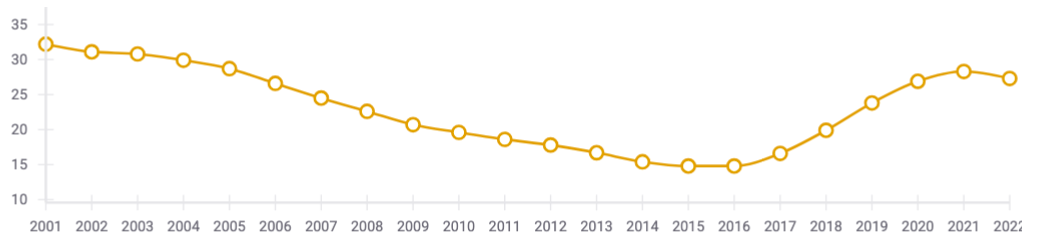
As Figure 1 illustrates, the number of undernourished citizens has increased precipitously since 2017/18, reaching 27.3 million in 2022 — levels of food insecurity not seen in the country since 2004/05.
This significant increase in food insecurity comes at a time when Abiy Ahmed, who rose to power in 2018, claims that Ethiopia is undergoing an “agricultural revolution” — with Ethiopia supposedly being both a net exporter of food and food self-sufficient.
Declining Government Expenditure on Health and Education
On SDG 3: Good Health and Well-being, there is a consistent decline in government expenditure on health, health services, and citizen well-being. According to the report, the proportion of total government spending on health was 3.9% in 2022, down from the 6-7% a decade ago. Government spending on health has regressed to 2005 levels.
Moreover, in absolute terms, between 2020-24, the health budget declined, from 51 billion Birr to 22.6 billion Birr — a 56% reduction. This decline in the health budget has led to deteriorating health services and outcomes. Consequently, Ethiopian citizens’ well-being score of 3.9 out of 10 is on the decline, according to the SDGs 2025 report.
Likewise, on SDG 4: Quality Education, the report finds a decline in government spending on education — from 23.3% in 2017/18 to 16.6% in 2024. In absolute terms, between 2020-24, the education budget declined from 123 billion Birr to 55.8 billion Birr — a 55% reduction.
Comparatively, between 2020-24, government spending on the military increased from 16.5 billion Birr to 65.7 billion Birr — a staggering 298% increase.
Figure 2: Proportion of total government spending on essential services, education (%)
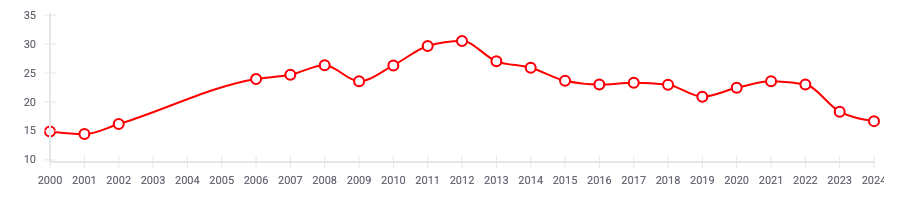
Due to the proliferation of armed conflict throughout Ethiopia, more than 9 million school-aged children are unable to attend school, while 5,500 schools have closed due to conflict and instability. Consequently, the SDGs 2025 report finds, the primary school enrollment rate declined to 76%, down from 88.7% in the 2021/22 school year, while the lower secondary completion rate declined to 22% from 33.1% in 2021/22.
Economic Stagnation
Lastly, on SDG 8: Decent Work and Economic Growth, the data, or lack thereof, paints an incomplete picture. The overall trend is that of “major challenges” and “stagnation”, according to the report. For instance, Ethiopia’s Adjusted GDP growth index score of 63.9 out of 100 has stagnated, while measures of fundamental labor rights (.37 out of 1) and access to financial institutions (46% of total population) are classified as “major challenges” to economic growth and structural transformation.

 Ethiopian Policy Institute