
The latest joint World Bank-IMF Debt Sustainability Analysis (PDF) warns of Ethiopia’s “debt distress” — labeling it “unsustainable.”
The World Bank and IMF assert: “Ethiopia faces political, economic, and humanitarian challenges, and its debt is assessed to be unsustainable, mainly due to protracted breaches of exports-related external debt indicators.” Furthermore, the joint analysis warns: “decline in foreign reserves and foreign direct investment (FDI) inflows” fundamentally undermine Ethiopia’s debt carrying ability and ability to service debt.
The report also reveals that Ethiopia’s debt repayment is complicated by the accumulation of both short-term and medium-term debt service payments. Ethiopia’s debt-carrying capacity is classified as being in “debt distress” following the default on a $1 Billion Eurobond that matured in December 2024.
In March 2025, the Abiy Ahmed regime reached an agreement in principle with official creditors under the G20 Common Framework. According to reports, a Memorandum of Understanding on debt treatment is expected soon, which, if fully implemented, could narrow financing gaps and ease debt distress risks to moderate levels by 2027/28, when the current IMF programme ends.
Nonetheless, the World Bank-IMF analysis warns that without successful restructuring and reforms, Ethiopia will face “pressures on both its liquidity and solvency” as debt service obligations continue to exceed export and government revenues. A challenge exacerbated by persistently low foreign exchange reserves, declining FDI inflows, and constrained fiscal space.
Furthermore, the World Bank and IMF emphasize that the Ethiopian economy remains highly vulnerable to export-related shocks and currency depreciation. Since liberalizing the exchange rate regime in July 2024, Ethiopia’s currency, the Birr, has depreciated by over 150% — with the official exchange rate sliding from 57 Birr/USD to 145 Birr/USD, while the parallel exchange rate is now upwards of 170 Birr/USD.
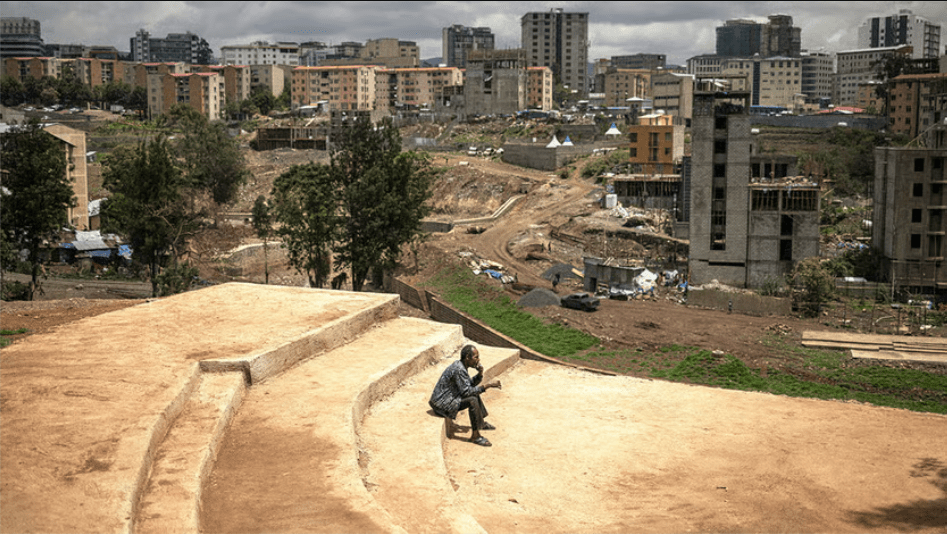
Similar to the country’s economic difficulties, sociopolitical challenges continue to proliferate, including ongoing armed conflict in the Amhara and Oromia regions. In addition to armed conflict, economic mismanagement and governance failures have led to corruption and the misallocation of resources on “vanity projects”, further exacerbating social, political, economic, and security challenges in Ethiopia under the Abiy Ahmed regime.

 Ethiopian Policy Institute